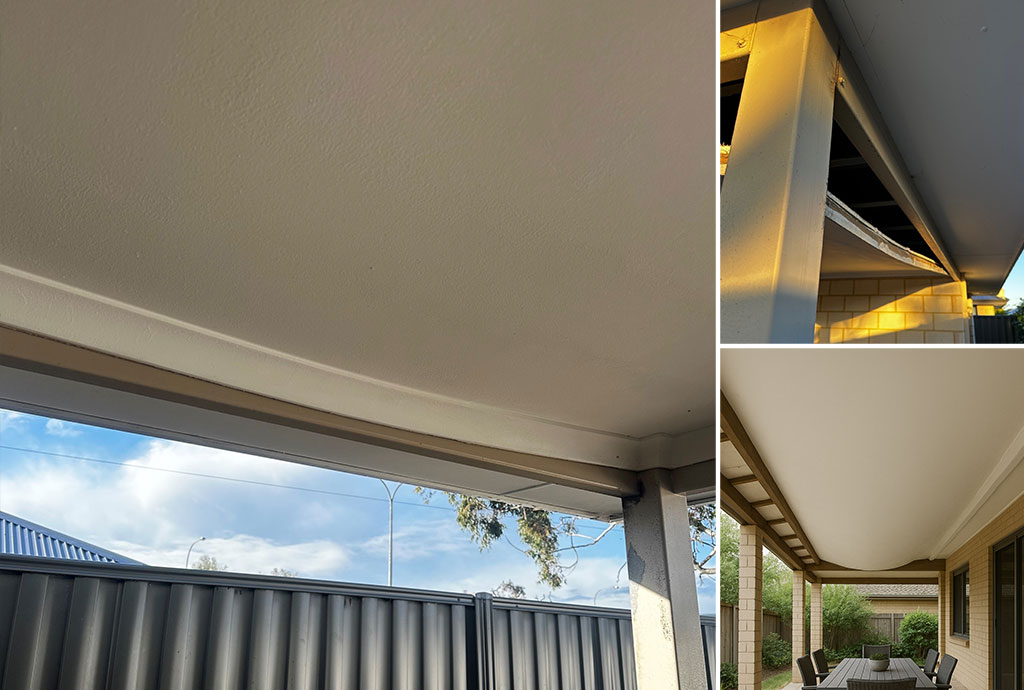
Many builders and homeowners experience issues with plasterboard ceilings in external alfresco areas sagging and eventually failing. This is a common problem, often stemming from a combination of material choices, installation methods, and environmental factors.
Installation & Product Shortcomings
- Incorrect Plasterboard: Often, standard plasterboard is installed instead of “Aquachek” product, which is designed for areas exposed to general air and structural moisture.
- Insufficient Fixings: Even with the correct board, there are often not enough screw fixings in addition to glue, which is crucial given the exposure of alfresco ceilings.
- Improper Adhesives & Compounds: The glue and jointing compound used should be “Gyprock Wet Area Base Product.” However, this is rarely used in these areas.
Environmental Stress & Lack of Protection
- Extreme Temperature and Moisture Fluctuations: Alfresco ceilings are typically never insulated, leaving them exposed to significant temperature and moisture variances. In winter, moisture gets absorbed by the boards. Then, during 40-degree Celsius days, the roof void temperature can soar to 70 degrees Celsius. This constant cycle causes minor shrinkage, twisting, and movement, leading to the breakdown of the glue compound over time.
- Unsealed Boards: Without insulation and when normal plasterboard is used, moisture can be sucked in through the top of the board, as it lacks a seal or paint application.
Cornice Failure
- Poorly Fixed Cornices: The cornices in these areas are often not adequately glued and fixed to the surrounding brick, steel, or timber perimeter. They are frequently the first components to detach and start sagging.
Inadequate Protection
- Insufficient Painting: Ceilings and cornices should be coated with a low sheen paint to help prevent moisture ingress, especially when Aquachek boards haven’t been used. Additionally, these areas should receive additional paint coatings every five years for ongoing protection.